
Deep tech companies – from photonics and semiconductors to quantum systems and advanced sensing – are among the most technically demanding in the STEM industries. Yet they remain among the least diverse corners of the modern workforce. Globally, women represent less than a third of the STEM workforce, compared with nearly half of workers in non-STEM roles, and the proportion drops further in engineering-heavy domains that underpin deep tech. For example, In the UK semiconductor industry, women account for only 26% of employees and just 18% in technical roles.
But while many deep tech organizations continue to struggle with representation, a new generation of startups is beginning to demonstrate that a more diverse workplace can drive a host of benefits, and Singular Photonics is one of them. The image sensor startup recently passed a significant milestone for a technology venture, announcing the first commercial deployment of its technology: a Raman spectroscopy collaboration with global instrumentation giant Renishaw. Unusually for a deep tech company, Singular has a high degree of ethnic and gender diversity in its workforce, particularly in its engineering team, which currently has a 50/50 mix of male and female employees.
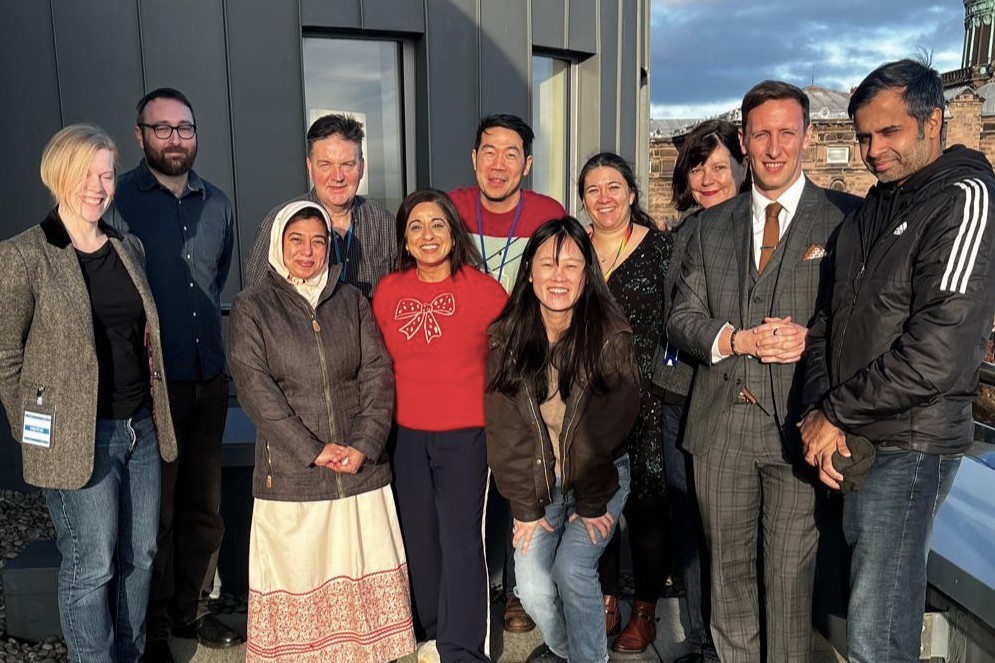
Singular CEO Shahida Imani has always believed that diversity isn’t about hitting numbers.
“It’s about creating an environment where people feel trusted, free to think independently, and confident that their ideas will be heard,” she says. “When those conditions exist, talented people from many different backgrounds want to be part of the journey – and that benefits the organisation enormously.”
Bucking the trend
For many employees at Singular, the lack of diversity in deep tech is a lived experience. Firmware engineer Dr. Yuanyaun Hua recalls that in previous engineering roles, teams were around 90–95% men. “In a group I often used to be the only female, but now at Singular, it’s more balanced,” she says.
Having spent most of her career in academia, Senior Optical Scientist and Applications Engineer Dr. Katjana Ehrlich echoes Hua’s sentiment.
“Working in physics, often I was the only woman in the room,” she says. “I love physics, and I’ve always loved my work, even when it was challenging. As a woman, you often have to work harder, do more extracurricular activities, and make yourself visible, yet still might be overlooked.”
These experiences mirror broader trends across the sector. Hardware-focused environments have historically attracted and retained a narrower demographic profile than software-centric fields, reinforcing a cycle in which homogeneity becomes self-perpetuating.
“From my experience in every organization I’ve worked with – whether a small company, a large organization, or an academic environment – engineering fields like electrical, electronics, computer science, and optics are dominated by men,” says Singular co-founder and CTO Dr. Aravind Venugopalan. “That’s why I’m actually very proud of what’s happening at Singular. If you look at similar deep tech or photonics companies, you probably won’t find the same gender ratio we have.”
Senior Software Developer Shu Chen believes that deep tech companies are missing out on valuable talent if their workforce has limited female representation.
“In tech, many women leave the field due to discrimination, harassment, or lack of role models,” he explains. “The women who stay are often exceptionally strong because they’ve had to overcome more barriers. In that sense, companies are doubly losing out by excluding them.”
Diversity drives innovation
At Singular, diversity is far from a numbers exercise. Hiring decisions are based on capability and fit rather than demographic targets, yet the result has still produced a team that is unusually balanced for a deep tech startup.
“When I first met the whole company at a planning day, I was struck by how diverse the team was,” says Software Engineer Matthew Coady. “In many workplaces, people tend to look or think similarly, which becomes part of the culture. At Singular, it felt like everyone was genuinely different – and that felt like a good sign.”
Hua concurs, noting Singular’s diversified environment in terms of nationality, race, and gender.
“I feel quite relaxed and comfortable because everybody is from different backgrounds and different countries,” she says. “There isn’t one dominant group. That makes it easier to communicate with people.”
The importance of mutual respect and effective communication in a startup cannot be understated and Ehrlich believes the environment at Singular is conducive to innovation.
“At Singular, I felt very welcome from the start, there’s good communication, a positive working environment, and plenty of opportunities – I’m very happy here,” says Ehrlich. “My role gives me a lot of freedom to both build things up and explore what could be new and interesting applications.”
“At Singular, there’s more openness to ideas, and I noticed from my very first meeting that discussions were open and democratic – everyone contributed and was listened to,” agrees Coady. “I also noticed how self-organizing the team is. People don’t need to be told what to do; they just coordinate naturally and make time to listen to each other.”
While skill and expertise remain the most critical drivers of success in any team, many of Singular’s employees point to an indirect but powerful effect of diversity: to create conditions where people feel respected and therefore more willing to contribute.
“It brings different ideas,” says Venugopalan. “People think in different ways. It’s a bit like combining different sets of data – the more diverse they are, the richer the result. Everyone at Singular has a different background and story. My experience is not the same as someone else’s, and when you bring those different perspectives together, you get better outcomes. Instead of having ten people with the same story, it’s better to have ten people with different stories who can bring different perspectives.”
“I feel like I get the respect and I appreciate that, and that makes me want to contribute more,” agrees Hua. “Here at Singular, I feel relaxed to do whatever I can. That makes a big difference.”
Strategic benefits
For deep tech, the implications of diversity are strategic as much as ethical, and Chen also highlights the importance of domain diversity in creating competitive advantage.
“Singular benefits from technical diversity,” he says. “I came from a software startup background with no hardware experience, but I brought practices around building stable software, rapid iteration, and moving from prototype to production. Meanwhile, colleagues from academia bring rigor, careful experimentation, and deep engagement with research. That mix of startup speed and academic depth is very powerful.”
“In deep tech, we’re trying to solve very hard problems,” says Venugopalan. “If everyone thinks the same way, you might still reach a solution, but it will likely take longer and require more effort. With diverse perspectives, solutions often emerge faster. We see this every day at Singular.”
But diversity does not in itself guarantee a harmonious working environment, and Singular’s first employee, Senior Manufacturing and Application Specialist Mark Mooney, says the company’s success in this area is down to one main factor: empathy.
“If senior management have empathy-driven core values, everything flows from that – it’s that simple,” he says. “If your leadership values empathy, fairness and respect, then naturally you’ll hire people based on their talent and personality rather than their background. You’re not ticking diversity boxes – you’re simply selecting the best people who fit the team. That naturally leads to a diverse workplace.”
The broader deep tech sector still has a long road ahead. At current rates, equal gender representation across STEM fields may not arrive until around 2070 – a timeline that underscores how slow progress has been despite decades of conversation.
“I think it’s an open secret that the playing field isn’t level, and there’s still a long way to go before equality,” says Ehrlich. “I would still encourage anyone – especially women – to pursue what they want, even though I know it can be tough.”
“Tech companies are missing huge amounts of talent because their hiring systems are biased,” says Chen. “If 99% of applicants are men in a world that’s 50% women, something is wrong with the recruitment process – job adverts, outreach, or evaluation criteria.”
Building the right culture
Despite the challenges facing the industry Singular’s experience so far suggests that startups have the opportunity to adopt a different trajectory. By building a culture where no single group dominates and where collaboration emerges naturally from varied backgrounds, the company is demonstrating that diversity can evolve organically without compromising technical excellence.
“I see diversity as a cultural thing that grows organically rather than something you can enforce through policies,” agrees Coady. “I think Singular’s culture needs to be nurtured day by day. If growth is gradual and people are mindful of preserving what makes the culture healthy, it should be possible to maintain it.”
According to Mooney, maintaining the culture as the Singular grows will come down to strong leadership.
“Right now the structure is simple, but as companies grow you introduce more layers of management,” he says. “That means group leaders and mid-level managers also need to embody those same values and pass them down to their teams. Of course, challenges will come as the company grows – the more people you hire, the more potential there is for culture clashes. But as long as we keep reinforcing those core values, I think we’ll be okay.”
“We never set out with a strict plan to engineer a specific demographic mix, yet it happened naturally,” adds Venugopalan. “We’ve been fortunate to meet resourceful, supportive people who wanted to join the team. I think that will continue.”
“In the earliest stages of a deep tech startup, you’re not just building a product – you’re building a culture,” concludes Imani. “If you build a culture based on trust, empathy and respect from day one, diversity isn’t something you have to force – it becomes a natural outcome of simply hiring the best people. The decisions you make about how people treat each other, how ideas are shared, and how problems are solved become the blueprint for everything that follows. If those foundations are built on empathy and fairness, the team becomes stronger, more creative and more resilient.”